AMSTERDAM
Ancient Buildings


 During the 14th, but especially the 15th century, Amsterdam underwent a rapid development, which laid the foundation for the Golden Age. Only very few medieval buildings survive today. Some examples: the Old and New Churches and the Houten Huis (Wooden House) at the Begijnhof. Throughout the Middle Ages houses were generally built of wood, a vulnerable type of construction material. Amsterdam has got almost 6,500 monuments, including churches, bridges, gables, and city furniture. Together they form one of the most important historic city centers in the world.

Amsterdam Oude Kerk
The Oude Kerk (Old Church) 1306
The Oude Kerk (Old Church) is the oldest building in Amsterdam. It was probably consecrated in 1306. A small wooden chapel with a cemetery already stood on the site of the Oude Kerk in the 13th century. The first stone church was built in 1306.
Amsterdam Nieuwe Kerk
Nieuwe Kerk (New Church) 1409
After the Oude Kerk grew too small for the expanding population of the town, the bishop of Utrecht gave permission to build a second parish church, the Nieuwe Kerk (New Church). Construction began in 1380 and finished in 1408. This new church was consecrated in 1409.
Amsterdam Houten Huis
Het Houten Huis 1420
The Begijnhof is an enclosed courtyard dating from the early 14th century. Begijnhof includes the Amsterdam's oldest surviving house "Het Houten Huis" (No. 34.) dating from around 1420. It is one of only two wooden-front houses in the city, as timber houses were banned in 1521 after a series of catastrophic fires.
Amsterdam Waag
The Waag (Weigh House) 1488
The Waag (Weigh House) on the Nieuwmarkt was built in 1488 as the Sint Antoniespoort (Saint Anthony's Gate), a city gate in Amsterdam's medieval city wall. The main gate and the outer gate were combined in the 17th century with the construction of an octagonal central tower.
Amsterdam Agnietenkapel
Agnietenkapel  1470
Agnietenkapel is the chapel of the Agnietenklooster (St. Agnes Monastery). A Gothic double chapel from 1470 with an upper church for the nuns. On the street side, in the wall enclosing the front courtyard, stands an early Renaissance gate from 1571 (replaced here in 1631).
Amsterdam Schreierstoren
Schreierstoren 1487
The Schreierstoren tower is located in the center of Amsterdam, opposite Central Station. Dating from around 1487, this tower was part of the first defensive works that were constructed from 1481 onwards. These works involved connecting the city gates and towers to each other by means of the city wall.
Amsterdam Montelbaanstoren
Montelbaanstoren 1516
Montelbaanstoren is a tower on the bank of the Oudeschans – a canal in Amsterdam. The original tower was built in 1516 as part of the Walls of Amsterdam for the purpose of defending the city and the harbour. The top half, designed by Hendrick de Keyser, was extended to its current, decorative form in 1606.
Amsterdam Rembrandt House
Rembrandt House  1606
Rembrandt House was built in 1606 and this date painted in gold decorates until today its facade. It is relatively wide, built on two adjoining lots, then in the new and fashionable eastern part of the city. It was a diverse neighbourghood, home of many artists and also the Jewish Quarter of the city.
Amsterdam Zuiderkerk
South Church (Zuiderkerk) 1611
South Church (Zuiderkerk), built in 1603-1611, designed by Hendrick de Keyser. It is a three-aisled pseudo-basilica on a rectangular plan, with the aisles on each side elevated in two places with a trapezoid gable. The beautiful Zuiderkerk tower is a fine example of Hendrick de Keyser's Amsterdam Renaissance style.
Amsterdam Munttoren
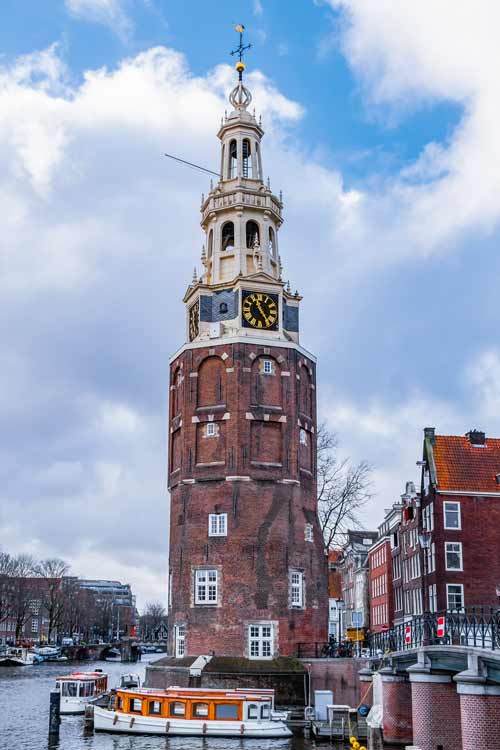
Munttoren (Mint Tower)  1620
The Munttoren (Mint Tower) is a remnant of the Regulierspoort gate, built between 1480 and 1487, part of the old medieval city wall. In 1619/20, a decorative spire, designed by Hendrick de Keyser in the Amsterdam Renaissance style, was erected on the remains of the Regulierspoort gate.
Amsterdam Noorderkerk
Noorderkerk (Northern church) 1623
The Noorderkerk (Northern church) was built in the years 1620–1623 to serve the rapidly growing population of the new Jordaan neighbourhood. The Jordaan already had a church, the Westerkerk, but the city government decided that a second church should be built to serve the northern part of the neighbourhood.
Amsterdam Westerkerk
Westerkerk (Western Church)  1631
The Westerkerk (Western Church) was built between 1620 and 1631 in Renaissance style according to designs by architect Hendrick de Keyser. The church has a length of 58 metres and a width of 29 metres. The three-aisled basilica has a rectangular plan with two transepts of equal dimensions.