Zaandam, a charming old town on the banks of the Zaan River in the northwestern part of the Netherlands. The town's history can be traced back to the 14th century when it began to flourish as a center for shipbuilding, milling, and trade due to its strategic location near Amsterdam. Zaanse Schans is a neighborhood in the Dutch town of Zaandam. Historic mills and characteristic green wooden houses have been relocated here to recreate the village's appearance from the 18th and 19th centuries. Zaanse Schans is a combination of residential buildings, businesses, museums, and mills. The Zaanse Schans grounds include a cheese factory, a clog workshop, a bakery museum, a pewter foundry, and numerous shops.
The "modern" town hall in Zaandam was designed by architect Sjoerd Seters and opened in 2010. It stands out with its façade inspired by the traditional green houses characteristic of the Zaan region.
Former town hall ("de Burcht" building), it was built in 1848 and served as the town hall until 1974.
Gedempte Gracht is an open-air pedestrian - only shopping street set along a canal just outside of Zaandam Station.
The Inntel Hotel is 12-story hotel, finished in 2010. The hotel, with its 70-stacked Zaanse houses features the Blue House, painted by Claude Monet.
Along the banks of the river Zaan: Hondsbossche Lock (1547) is a monument to Dutch engineering history, and was intended to transport materials for coastal fortifications along the Zaan River.
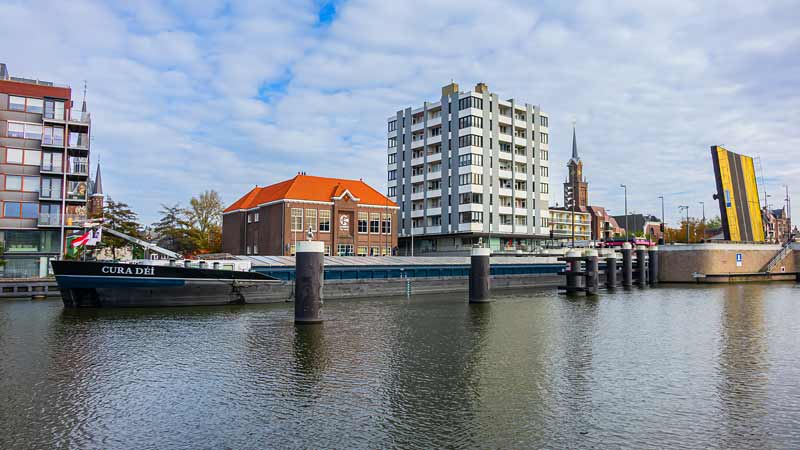
Beatrix Bridge (Beatrixbrug) is a striking lifting bridge that dates back to the 1950s.
Building Meypro Phenix (an old rice warehouse industrial building) and Filmtheater De Fabriek.
Picturesque view of a street in Zaandam.
Zaanse Schans
Traditional Dutch old wooden windmill.
Interior of traditional Dutch old wooden windmill.
Traditional Dutch house in small typical Dutch village-museum.
The museum of clogs, a traditional wooden shoe klompen - symbol of Netherlands.
Beautifully painted Dutch traditional wooden shoes in museum shop.